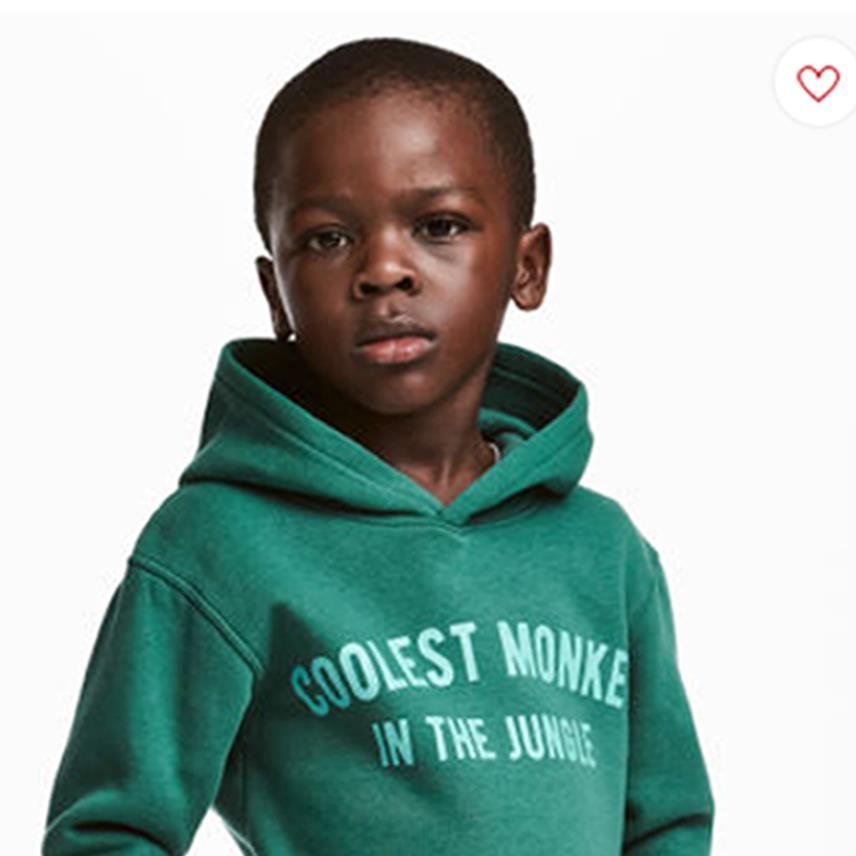
In January 2018, clothing retailer H&M published an image on its website advertising a children’s hoodie with the slogan “Coolest Monkey in the Jungle.” The hoodie was modelled by a Black child. Within hours, the image began circulating widely on social media, and so did the reaction. What might have been dismissed by some as a careless mistake was immediately recognised by many others as something far more serious.
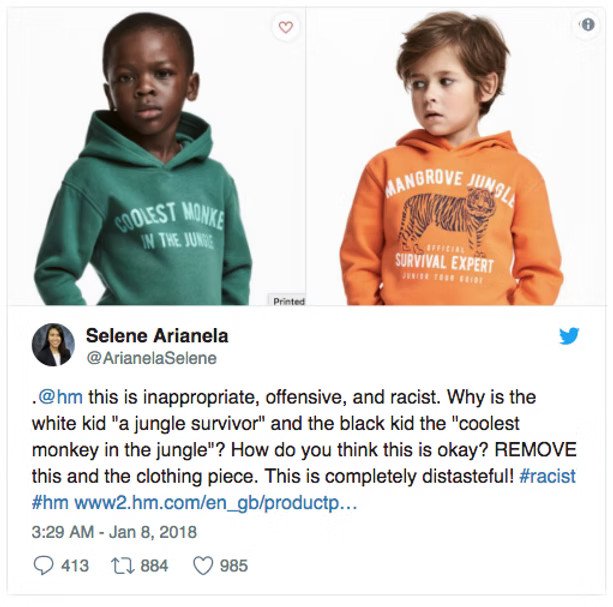
The phrase “monkey” has a long and painful history when applied to Black people. It has been used for generations as a racial slur, a way of dehumanising Black bodies and justifying exclusion, violence, and ridicule. That context is not obscure. It is not niche knowledge. It is foundational to understanding race and representation in Western media. The idea that such an association could appear in a global advertising campaign without triggering alarm reveals a deeper problem than a single bad decision.
H&M’s initial response was swift but limited. The company removed the image and issued an apology, stating that it regretted the offence caused and would review its internal processes. That apology acknowledged harm, but it did not fully address how the image made it through multiple layers of approval in the first place. Campaigns of this scale do not happen by accident. They are the product of planning, review, and sign-off by teams of people.
This is where Representation Watch places its focus. The issue was not simply the hoodie or the slogan. It was the absence of anyone in the decision-making chain with the authority, awareness, or willingness to say: this is not acceptable.
The backlash was immediate and global. Public figures condemned the image. Protests erupted outside H&M stores in several countries. Artists and collaborators publicly cut ties with the brand. The anger was not performative. It was rooted in exhaustion. For many observers, the hoodie was not an isolated error but another example of how Black children, in particular, are subjected to casual harm in commercial imagery.
H&M later announced structural changes, including the appointment of a diversity leader and commitments to improve internal representation. These steps were necessary, but they also raised an uncomfortable question: why did such measures only arrive after public humiliation and financial risk?
Too often, corporations treat representation as a branding issue rather than an ethical responsibility. Diversity becomes something to manage after harm occurs, rather than something embedded in how decisions are made. In these environments, harm is framed as unforeseen rather than predictable, and apologies are issued without fully reckoning with the systems that allowed the mistake.
There was also an attempt in some corners of public discourse to reframe the controversy as oversensitivity. Defenders argued that the phrase was harmless in isolation, that no racist intent was present, or that outrage culture had gone too far. These defences misunderstand how representation works. Meaning does not exist in isolation. It exists in history, in power dynamics, and in lived experience. Ignoring that context does not neutralise it.
The “Coolest Monkey” hoodie became a flashpoint because it revealed how little margin for error exists when powerful companies operate without cultural competence. It showed what happens when global brands market to diverse audiences while remaining insulated from those audiences’ realities. And it demonstrated that accountability, when it comes, is often reactive rather than preventative.
Representation Watch does not view the H&M incident as a morality play about individual blame. It is a case study in institutional failure. A failure to recognise how imagery circulates. A failure to understand the weight of language. And a failure to take representation seriously until reputational damage forces action.
The lesson is not simply that brands should “be more careful.” It is that care must be structural. It must be embedded in who has power, who is listened to, and whose perspectives are treated as essential rather than optional.
The hoodie is no longer sold. The image has been removed. Apologies have been issued. But the incident continues to matter because it illustrates how easily harm can be produced when representation is treated as a secondary concern. Accountability is not just about responding after the fact. It is about changing the conditions that make such failures possible.
For audiences, the backlash was a reminder that public pressure can force change. For institutions, it was a warning. Representation is not a decorative layer applied at the end of a campaign. It is part of the substance. Ignoring that reality is not neutral. It is a choice, and one that carries consequences.