
Religious garments are not just clothes. They are signals of devotion, discipline, belonging, and restraint. They carry rules about who may wear them, when, and why. When those garments appear on concert stages or in glossy music videos, detached from belief or practice, the result is often defended as “art” or “provocation.” But intent doesn’t erase impact – especially when sacred meaning is converted into visual shorthand for shock, mystique, or rebellion.
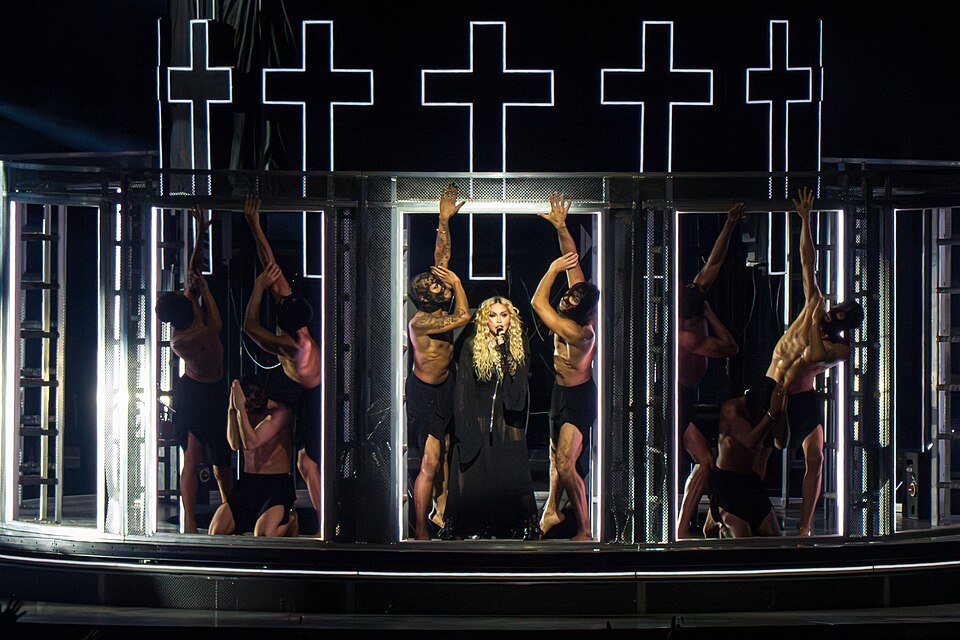
Pop music has a long history of drawing power from religious imagery. In the 1980s and 90s, Madonna built an entire aesthetic around Catholic symbolism: crucifixes worn as jewelry, lace veils styled as fetish accessories, confessionals turned into sets. To some, this was a critique of institutional power. To others, it felt less like commentary and more like extraction – sacred objects reduced to props once their cultural authority could be repurposed as edge.
More recently, religious symbolism from non-Western traditions has also been treated as interchangeable stagewear. In 2013, Katy Perry’s Unconditionally performance at the American Music Awards featured imagery drawn from Shinto practice, including torii gates and styling resembling shrine attendants. The performance framed these elements as exotic visual shorthand rather than as part of a living religious tradition. While visually elaborate, the use of sacred symbols was detached from their spiritual meaning, offered without explanation, consultation, or acknowledgment of the beliefs they represent. The result was spectacle without context, where religious iconography functioned as mood-setting rather than meaning-bearing.
This pattern repeats: sacred dress used to signal “exotic,” “forbidden,” or “elevated,” while the communities for whom those garments remain regulated and meaningful are excluded from the stage. Muslim women face discrimination for wearing hijab in public life, yet veils regularly appear in pop performances as symbols of mystery or submission. Catholic nuns’ habits – worn to signify vows of humility – are repeatedly sexualized in music videos. Hindu bindis and temple jewelry circulate freely in fashion editorials, even as South Asian women are told they look “too ethnic” in professional settings.
Defenders often argue that religion is powerful because it is visible – that art has always borrowed from belief systems. That’s true. But borrowing implies exchange. What’s missing in many of these cases is accountability: no acknowledgment of restrictions placed on actual believers, no recognition of the risks carried by those who wear these garments outside of a protected celebrity context, and no credit to the cultures being mined.
It’s also worth noting who gets to experiment safely. A pop star can remove a religious garment the moment it stops serving the performance. A believer cannot. When sacred dress becomes costume, meaning becomes optional – and that asymmetry matters.
Representation Watch is not calling for bans or moral panic. The issue is not exposure, but imbalance. If religious garments are used as visual language in popular culture, they deserve context, collaboration, and restraint. Otherwise, what is presented as artistic freedom begins to resemble something else: belief systems stripped for parts, their weight carried only by those without the option to take the costume off.
Sacred objects do not lose their meaning just because a stage is brightly lit. The question is whether the industry is willing to treat them as more than set dressing.


.jpg)